
Who’s Got the Microphone?
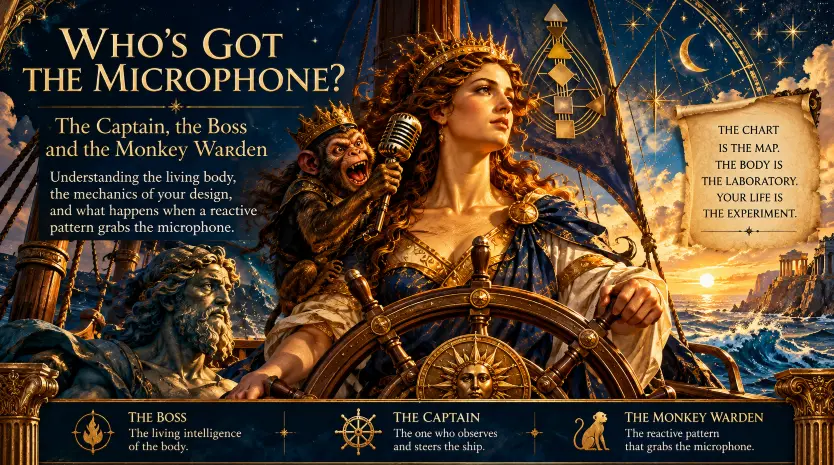
Who’s Got the Microphone?
JILLIAN EVELYN HD · TEACHINGS
The Captain, the Boss and the Monkey Warden
THE LIVING BODY · THE MECHANICS OF YOUR DESIGN
The Captain, the Boss and the Monkey Warden
Understanding the living body, the mechanics of your design, and what happens when a reactive pattern grabs the microphone. Have you ever known something wasn’t right, only to find yourself talking yourself out of it? Have you promised to do something you didn’t really want to do, rushed into fixing a problem that wasn’t yours to fix, or found yourself reacting before you’d had time to take in the whole situation?
Perhaps you’ve spent hours going around in circles, trying to work something out, prove a point or make everything right. And afterwards, you’ve wondered: Why did I do that? I knew better. What if we could understand these moments without turning them into another label about who we are? I’d like to introduce you to three characters: the Captain, the Boss and the Monkey Warden.
They offer a way to explore the living mechanics of the human being, the signals we receive, the patterns that influence our behavior, and the difference between observing what is happening and reacting automatically. And once you meet the Monkey Warden, you may begin recognsing him in places you never noticed before!
Meet the Boss: The Body Is Already at Work
Let’s begin with something we rarely stop to consider. Your body doesn’t wait for you to tell your heart to beat, your lungs to breathe or your digestive system to get on with its work. Your body is already active, responding to its environment and carrying out the processes that sustain your life. It doesn’t sit quietly waiting for your mind to give permission.
The living body is doing what a living body does. Within my approach to True Sidereal Human Design, the bodygraph gives us a map through which to explore the body’s mechanics. The centers, channels, gates and their relationships offer a framework for investigating how the living system operates and how its different parts interact. I call the body’s ongoing intelligence the Boss.
The Boss isn’t a little person hiding inside you, issuing orders. It’s a character in our teaching metaphor, representing the living activity of the body itself. Think about the difference between knowing something intellectually and noticing what your body is communicating. You might tell yourself that you’re perfectly happy to take on another commitment, while your body is exhausted. You might convince yourself that a situation is fine while noticing that something about it doesn’t sit comfortably with you.
Those signals deserve attention. They don’t automatically dictate the answer, but they give you something to investigate. The question is not whether your body is doing its job. The question is whether you’re paying attention to what it is communicating, how you’re interpreting those signals, and what happens next. And this brings us to our second character.
Meet the Captain: Who Is Steering the Ship?
Imagine yourself aboard a ship. The sea is moving. The wind changes. Other vessels cross your path. Sometimes the water is calm; sometimes a storm appears without warning. The ship is already moving. You don’t need to make the sea stop before you can navigate it. You need a Captain. In my metaphor, the Captain represents your capacity to observe what is happening, recognize what deserves your attention and steer your life consciously.
The Captain doesn’t need to control every wave. The Captain needs to understand the conditions and navigate them. This is where your personal authority becomes important within the exploration of Human Design. Rather than treating the chart as a list of instructions to follow blindly, we can use it as a map for investigating our own mechanics. We can observe what happens in our lives, notice recurring patterns and explore how our design may help us understand those experiences. The Captain asks questions.
- What is actually happening here?
- What have I noticed?
- What information do I have?
- Am I responding to the situation itself, or reacting to pressure, fear or an assumption I’ve already made?
And perhaps the most important question of all: -> Am I steering this ship, or has something else taken the helm? Because there is another character aboard. And he has a habit of grabbing the microphone.
Meet the Monkey Warden
The Monkey Warden is one of my favorite teaching characters because he makes something abstract visible. Human Design has a term for patterns that operate outside a person’s own Strategy and Authority: the Not-Self. But repeating a label doesn’t necessarily help someone recognize what is happening in their everyday life.
- What does the pattern actually look like?
- How does it behave?
- What does it do when it takes over?
That’s where the Monkey Warden comes in. Imagine a mischievous monkey who suddenly grabs the microphone, jumps onto the Captain’s chair and announces that he knows exactly what needs to happen. He doesn’t want to wait for the whole picture. He doesn’t want to examine every possibility. He’s already decided that something must be done, fixed, proved or controlled. And off he goes!
The Monkey Warden might be driven by fear, pressure, the need to please, the desire to prove your worth, or the belief that you must have an answer immediately.
- He might convince you that you must fix everyone else’s problems.
- He might keep you analyzing a situation long after the useful information has been exhausted.
- He might push you into making a commitment simply because you don’t want to disappoint someone.
- Or he might convince you that if you don’t act immediately, everything will fall apart.
- He might persuade you to say yes when you really want to say no.
Sound familiar? The Monkey Warden doesn’t always arrive with a warning bell. Sometimes he sounds remarkably reasonable. He can even convince you that he’s being helpful. That’s what makes him worth observing. The Monkey Warden isn’t who you are. He’s a character representing a pattern you can learn to recognize. When we identify with the behaviour, it can feel as though there is something wrong with us. When we learn to observe the pattern, we gain another way to understand what’s happening. Instead of asking, What’s wrong with me?, we can ask:
- What has grabbed the microphone?
- What is driving this reaction?
- What am I trying to prove, avoid or control?
- What did I notice before the monkey took over?
- And what might happen if I let the Captain take another look?
We don’t need to wage war against the monkey. We need to understand what he does and recognize when his behavior is no longer helping us.
When the Monkey Warden Grabs the Microphone
Let’s look at some everyday examples. The promise you didn’t really want to make Someone asks you for a favor. Before you’ve even considered whether you have the time or energy, the answer comes out of your mouth. Of course! No problem. I’ll do it. Then reality catches up. You’re exhausted, you’ve already committed to three other things, and now you’re trying to work out how to fulfil a promise you never properly considered. What happened?
Perhaps you genuinely wanted to help. Perhaps you felt pressured. Perhaps you didn’t want the other person to think badly of you. The important thing is to investigate rather than assume. The Monkey Warden may have grabbed the microphone before you had a chance to consider the commitment. The problem you feel compelled to fix Someone tells you about a difficulty they’re experiencing.
You immediately begin offering solutions, making suggestions and working out how to put everything right. Before long, you’re more invested in solving the problem than the person who originally brought it to you. But did they ask you to fix it? Were they looking for advice, or did they simply want someone to listen? The Monkey Warden can mistake the urge to act for a genuine need to act.
The Captain can take a step back and examine what’s actually being asked. The signal you talked yourself out of Something about a situation catches your attention. You notice a behavior that doesn’t sit comfortably with you. But instead of examining what you’ve noticed, you begin making excuses. Perhaps you’re being unfair. Perhaps you’re imagining things. Perhaps you should give the person another chance.
There may be perfectly good reasons to reconsider your initial interpretation. Observations can be incomplete, and first impressions can be mistaken. But there’s a difference between examining a signal and dismissing it automatically. The Captain can hold the observation open for examination without rushing to a conclusion. The answer you must have right now. You encounter a question you cannot immediately resolve. Instead of allowing yourself to investigate it, you become increasingly frustrated. You search, analyze, repeat the same thoughts and try to force an answer into existence.
The Monkey Warden insists that uncertainty is unacceptable. But sometimes, the most useful thing you can do is recognize what you don’t yet know. You can continue observing, gathering information and exploring the question without demanding an immediate conclusion. The monkey wants the microphone. The Captain wants to see the whole picture. These examples are not diagnoses, and not every reactive moment has the same cause. Their purpose is to help you recognize patterns in your own behavior and investigate what may be driving them.
The Nine Officers and Their Microphones
This is where the metaphor connects with my Nine Officers framework. I use Greek archetypes to explore the nine centres of the bodygraph. Each Officer represents a distinct realm of the living system, with its own characteristics and relationships to the other centers. The Officers don’t operate in isolation. Their connections matter, and the way a centre is expressed must be explored in relation to the person’s wider design. The Monkey Warden gives us another question to investigate: what happens when a reactive pattern interferes with the expression of an Officer?
Apollo — The Head
Apollo represents the realm of inspiration and the pressure to think about questions. The Monkey Warden might turn that inspiration into an endless demand to find answers, even when a question doesn’t need to be solved immediately. The invitation is to notice the difference between being inspired by a question and feeling compelled to resolve it.
Hermes — The Ajna
Hermes represents the realm of concepts, ideas, patterns and mental processing. The Monkey Warden might seize an idea and refuse to let it go. It may keep analyzing, defending an interpretation or insisting that everything must make sense before life can continue. The invitation is to explore ideas without becoming imprisoned by the need to be certain about everything.
Hephaestus — The Throat
Hephaestus represents expression. The Monkey Warden might push someone to speak before they have considered what they want to communicate, or encourage them to keep explaining until somebody agrees. The invitation is to notice not only what wants to be expressed, but how and why that expression is happening.
Aphrodite — The G Center
Aphrodite represents identity, direction and the experience of being oneself. The Monkey Warden might encourage someone to change themselves to fit another person’s expectations or become preoccupied with finding the one correct identity they must maintain. The invitation is to explore who you are becoming without turning identity into another performance.
Eros — The Ego/Heart
Eros brings us to will, commitments, agreements and worth. Here, the Monkey Warden may be particularly recognizable. It might push someone to prove they are capable, promise more than they can sustain, or work themselves into exhaustion to demonstrate their value. The invitation is to examine the commitments you make and the reasons behind them. Your worth doesn’t need to be turned into a competition.
Artemis — The Spleen
Artemis represents instinct and the realm of immediate awareness associated with the Spleen. The Monkey Warden might drown out a signal through fear, rationalization or the desire to hold on to something familiar. The invitation is to notice what you experience, examine the circumstances and distinguish an initial signal from the story you subsequently build around it.
Dionysus — The Sacral Center
Dionysus represents the realm of life force, energy and engagement. Hestia’s sacred hearth offers an image of this energy: a fire that can be sustained, diminished or made to flare depending on its fuel. The Monkey Warden might drive someone to keep going, prove their worth through constant activity or overlook what truly nourishes them. The invitation is to explore what fuels your energy and how it finds meaningful expression..
Poseidon — The Solar Plexus
Poseidon represents emotional experience and the movement of the emotional wave. The torch illuminating a dark cave offers an image of what comes into view. The Monkey Warden might react as though every feeling demands immediate action, dismiss an emotional signal or insist that nothing can be known until a prescribed period has passed. The invitation is to explore what is being illuminated and how emotional experience unfolds within your wider design.
Kronos — The Root
Kronos represents pressure and the drive to move, resolve or complete something. The Monkey Warden might turn pressure into panic, making everything seem urgent and every unfinished task unbearable. The invitation is to recognize the pressure and explore the difference between genuine urgency and the feeling that everything must happen now
Your Design Is a Living Experiment

Human Design can easily become a collection of labels if we forget why we’re examining the chart in the first place. A label may give us a name for something, but the name alone doesn’t tell us how that pattern operates in our lives. This is why I return to observation.
- How do you experience pressure?
- What happens when you act immediately, and what happens when you take time to observe?
- How does your energy respond to different activities and environments?
- What do you notice when you’re around other people?
- What happens when you make a commitment?
These are questions to investigate through your own experience. In my True Sidereal Human Design work, the bodygraph provides the map. The Nine Officers give the centers a mythic identity through which we can explore their mechanics. The Monkey Warden gives us a character we can recognize when reactive patterns begin to interfere. None of this requires you to condemn yourself for being human.
You can notice that you overpromised without deciding that you’re incapable of keeping commitments. You can recognise that you’ve reacted under pressure without turning that reaction into your identity. And you can discover that a familiar pattern no longer serves you. Recognition creates an opportunity to choose. That is the purpose of the experiment: not to force yourself into an ideal version of your design, but to investigate how your own living system operates and what happens when you become more aware of it.
Who’s Got the Microphone Now?

The next time you catch yourself rushing, overpromising, overthinking or trying to fix everything, you might recognize a familiar little character. The Monkey Warden has grabbed the microphone. You don’t need to panic. You don’t need to condemn yourself. And you don’t need to spend the rest of the day fighting the monkey. Simply begin by observing.
- What is the monkey trying to achieve?
- What did you notice before the reaction took over?
- What information still needs examining?
- What triggered the reaction?
And what happens when you give yourself an opportunity to choose your next move? The Captain doesn’t need to silence every voice aboard the ship. The Captain needs to recognize what’s happening and steer with awareness. The Boss continues doing the work of keeping the living body functioning. The Officers provide a framework for exploring the body’s mechanics. The Monkey Warden gives us a way to recognize reactive patterns. And you get to investigate what happens in your own life.
A Final Thought
You are not a collection of labels. You are a living human being, with a body that functions, signals that can be observed, experiences that can be examined and patterns that can be explored. Your design is not something to memorize and then spend your life trying to perform correctly. It is a map for investigation.
The chart is the map. The body is the laboratory. Your life is the experiment.
So, the next time the microphone gets snatched, take a breath and have a look.
Who’s speaking? – Who’s listening?
And who’s steering the ship?
Continue Exploring
Meet the Nine Officers → Explore the nine centers through their Greek archetypes, their mechanics and the gifts they bring to the living system.
Explore the Nine Centers → Discover the nine centers and the different realms of the body’s mechanics.
True Sidereal vs. Tropical Human Design → Discover how calculating your design from the real astronomical sky differs from the Tropical system.
Discover the Royal Decree → Explore a deeper reading of your mechanical and mythic design.